

Chapter 6 - Trading Psychology
Index
6.1 Trading Psychology : How it Impacts Your Success as a Trader
6.2 The Psychology Index - Your Key to Mastering the Trading Mindset
6.3 Gems of Trading Wisdom - Lessons for Trading and for Life
6.4 Your Biggest Mistakes in Trading
6.5 Your Biggest Assets in Trading - the Qualities That Define Long-Term Success
6.1 Trading Psychology : How it Impacts Your Success as a Trader
Trading psychology is the third pillar of our Trading System. It refers to the mindset and emotional state with which a trader approaches the market. It influences how you make decisions, manage risk, and respond to both profits and losses. It is the invisible force that shapes your overall performance.
Here is the fundamental truth - Your edge does not lie in chart reading skills. Your edge lies in executing your system consistently and mechanically. You can have the best knowledge, the best strategy, and the most refined system, but if you are unable to follow your process, your results will remain inconsistent at best. The market rewards discipline first and talent later.
One of the most important aspects of trading psychology is emotional control. Markets have a unique way of triggering strong emotions such as fear, greed, and anxiety, primarily because real money is at stake. These emotions often show up in subtle ways—jumping into trades out of fear of missing out, holding on to losing positions, or revenge trading in an attempt to recover losses. Successful traders are not those who eliminate emotions, but those who learn to manage them and continue to follow their system despite these internal pressures.
Closely linked to this is the quality of decision-making. Emotions tend to cloud judgment and lead to impulsive actions. Traders often feel the need to constantly be in the market, but in reality, consistent profitability comes from taking a few high-quality trades rather than trading excessively.
Another important factor to consider is the presence of psychological biases. Traders, like all humans, are prone to biases such as confirmation bias, overconfidence, and loss aversion. These biases distort perception and push you away from your proven process. Awareness of these tendencies, and actively working to correct them, is essential for long-term sustainability.
Trading also brings with it a significant amount of stress which is amplified when traders try to chase every opportunity or take on too much risk by increasing volume. Limiting yourself to a few well-understood setups and managing risk prudently helps reduce stress. Taking regular breaks helps you to break the monotony and recharge your mind. Managing stress effectively is therefore not just important for performance, but also for maintaining mental balance.
In essence, trading psychology forms the foundation on which all successful trading is built. It is not just about controlling emotions in isolation, but about building habits and processes that prevent those emotions from taking over in the first place.
This naturally leads to an important question: if trading psychology carries such a significant weight, is there a way to objectively assess where you currently stand, and more importantly, how you can improve on it consistently?
In the next section, we introduce the Psychology Index, a proprietary tool designed to measure your trading psychology in a structured and objective manner. It evaluates your adherence to a set of non-negotiable trading rules that are critical to building emotional resilience and maintaining psychological balance in the markets.
6.2 The Psychology Index - Your Key to Mastering the Trading Mindset
Welcome to the Psychology Index (PI), our proprietary tool designed to help you develop a rock-solid trading mindset. Think of it as the soul of your trading journey. Even the most technically skilled traders can't succeed without a disciplined mindset, and that's where the PI comes in.
Why is the Psychology Index a crucial pillar of our Trading System?
The PI is a tool that helps you build and maintain the best trading habits. It provides an objective score that you can use to track your progress and ensure you're developing the discipline and character needed for long-term success.
Look at the table below that provides the rules and the scoring system.
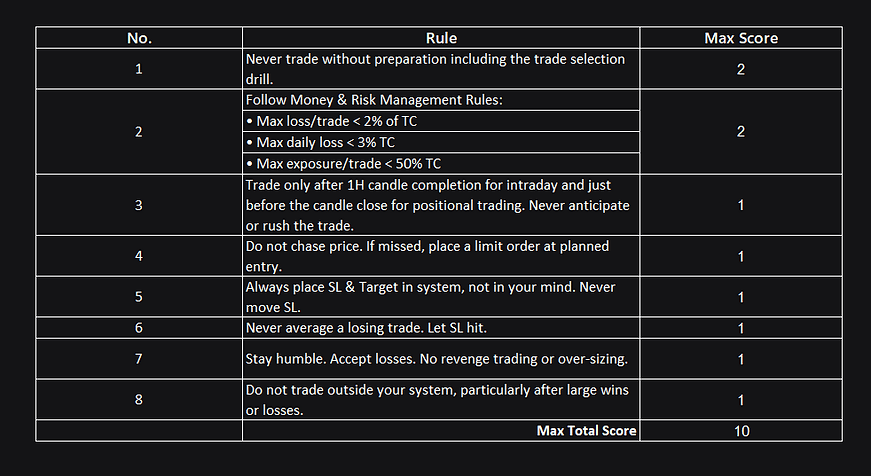

Note: Some rules, like Trade Selection, Max Loss, and Max Exposure, are non-negotiable. They have higher weights because sticking to them is essential for keeping your trading career alive.
How to Use the PI
At the end of each trading day—or at the start of the next—set aside five minutes to evaluate yourself against these rules. The key to making this exercise meaningful is honesty. Score yourself truthfully for each rule, without judgment or bias.
Once you’ve completed the scoring, add up the total to get a clear assessment of your trading behavior for that day. Make this a daily habit. Over time, maintain a simple day-wise record and plot your scores on a graph.
This visual trend will act as a mirror, showing whether you are improving, staying stagnant, or slipping in your discipline. If you notice that your performance is not improving—or worse, declining—take time to reflect and identify what needs to change in your trading behavior.
At the end of the day, progress begins with awareness. What you consistently measure is what you can improve. A simple but structured exercise like the one above will ensure you do not go off the track.
6.3 Gems of Trading Wisdom - Lessons for Trading and for Life
This section is dedicated to a collection of timeless gems of wisdom—principles that apply not just to trading, but to life itself. Wisdom is one of the highest pursuits. It is something you must consciously seek, nurture, and refine over time. In many ways, your journey as a trader is also a journey toward greater awareness and understanding.
Interestingly, much of what makes a trader successful has deep parallels with spirituality and life philosophy. The same principles that bring inner balance and clarity also help you navigate the markets more effectively.
Gem 1 – Surrender
At the heart of spirituality lies the idea of surrender—letting go of ego and allowing a higher force to guide you.
In trading, this translates into surrendering to the market. Let go of your need to be right. There should be no anxiety, no urgency—just a quiet alignment with the rhythm of the market. Listen to what the market is telling you, instead of forcing your own opinions onto it. When you do this, you begin to see opportunities more clearly and participate in what the market is willing to offer.
Gem 2 – Awareness of Thoughts
Thoughts have immense power. They shape both your inner world and your actions.
As a trader, your thoughts directly influence your emotional stability. Negative thoughts driven by greed, fear, or anger often lead to poor decisions, even when you have a strong trading system. The key is to become an observer of your own thoughts—catch them early, filter out the negative ones, and consciously shift your mindset. Over time, this awareness strengthens both your mental resilience and your trading outcomes.
Gem 3 – Discipline vs Greed
Every trading day is a quiet battle between discipline and greed.
If discipline wins, you preserve your capital and live to trade another day. If greed takes over, the consequences are often immediate and damaging. Long-term success belongs to those who consistently choose discipline.
Gem 4 – Honesty vs Hope
Honesty is your greatest ally in trading.
Be brutally honest with yourself—about your mistakes, your decisions, and your adherence to the system. Hope, on the other hand, is dangerous. Holding onto losing trades in the hope that they will turn around is one of the fastest ways to incur large losses. In the market, hope does not protect you—truth does.
Gem 5 – Humility vs Pride
Every trade begins with the belief that you are right.
But when the market proves you wrong, humility becomes essential. The ability to accept being wrong and exit quickly is what protects your capital. Pride, if left unchecked, prevents you from taking small losses and often turns them into large ones.
Gem 6 – Steady vs Hasty
Wealth in trading is built gradually.
Consistent, steady gains over time create lasting success. On the other hand, rushing for quick profits through impulsive decisions often leads to setbacks. Patience and consistency always outperform haste.
Gem 7 – Diligence vs Laziness
Success in trading demands effort.
Preparation, analysis, and disciplined execution are non-negotiable. Use the tools available to you—trade selection, risk management, and structured planning. Diligence compounds over time, while laziness slowly erodes your edge.
Gem 8 – Patience vs Impatience
Patience in trading is not passive—it is selective.
Be patient while entering trades. Wait for the right setups, the right conditions, and the right alignment of factors. However, once in a trade, be quick to act if things go wrong. Hold your winners patiently, but cut your losers without delay.
Gem 9 – Lifelong Learning
Trading is a continuous learning process.
Stay curious. Learn from books, from other traders, and most importantly, from your own experiences. Every mistake carries a lesson. Over time, this learning shapes your intuition and deepens your understanding of market behavior.
Gem 10 – Preservation Above All
Your first goal as a trader is survival—both financial and emotional.
Small losses are part of the game, but allowing them to grow due to ego or negligence can be damaging. Protect your capital and your confidence. If you stay in the game long enough, opportunities will come. Survival is the foundation of long-term success.
That is the real secret to making it big.
Gem 11 – Process Over Money
Shift your focus from outcomes to process.
Your trading system and its rules are far more important than the result of any single trade. Think of money as a resource—a means to execute your process, not the end goal. If you stay committed to the process, the outcomes will eventually take care of themselves.
Gem 12 – Nurture Your Mind
Your mental state directly impacts your decisions.
Avoid trading when you are stressed, distracted, or emotionally unsettled. Do not trade with borrowed money or capital you are afraid to lose. You don’t need to trade every day to be successful. In fact, taking breaks and stepping away can often improve your performance.
In trading, less is often more. What truly matters is your ability to make sound decisions when you do choose to trade.
6.4 Your Biggest Mistakes in Trading
Mistakes are an inevitable part of trading. In fact, the market is designed in a way that often tempts you into making them. However, what separates a consistently successful trader from one who struggles is not the absence of mistakes—but awareness.
A deep awareness of your mistakes allows you to observe, correct, and evolve. This journey of self-awareness is what ultimately shapes your success as a trader.
Mistake 1 – You Listen to Opinions
One of the biggest traps in trading is relying on opinions—whether they come from others or from within.
The market does not reward opinions; it rewards objectivity. When you trade based on what you think instead of what you see, you disconnect from reality. Opinions create expectations, and expectations give rise to hope—a dangerous emotion in trading.
Trade what you see, not what you think. The moment you let go of opinions, you free yourself to respond to the market as it is, not as you want it to be.
Mistake 2 – You Are Dishonest with Yourself
Dishonesty in trading is subtle but destructive.
You hold on to losing trades, convincing yourself they will turn around. You move your stop losses to “give the trade more room.” You reinterpret charts to suit your bias. In doing so, you are not deceiving the market—you are deceiving yourself.
Deep down, you know when you are breaking your rules. Yet, instead of accepting it, you justify your actions. The market has a way of punishing this behavior swiftly, often leading to financial and emotional ruin.
Mistake 3 – You Cannot Accept Losses
If you struggle to take losses, the real issue is not your strategy—it is your ego.
Losses are a natural part of trading. Trying to avoid them at all costs leads to poor decisions—holding on, averaging down, or deviating from your plan. What starts as a small loss can quickly grow into something far more damaging.
Accept small losses gracefully so you can stay in the game. Those who survive are the ones who live to trade another day.
Mistake 4 – You Overtrade
Overtrading is often a symptom of deeper issues.
You may be driven by greed, constantly chasing the next opportunity without proper evaluation. At times, it stems from boredom or the need for excitement—the urge to always be in a trade. In other cases, it comes from emotional pressure, especially trading in revenge trying to recover losses.
It can also arise from poor risk management—trading with inadequate capital, excessive exposure, or a lack of a structured system. At its core, overtrading reflects a lack of selectivity. Not every opportunity is worth taking. Only quality trades matter.
Mistake 5 – You Lack Perspective
Many traders operate without understanding the bigger picture.
Before entering a trade, it is essential to step back and assess the broader context. Where is the market in relation to its past movement? What is the prevailing trend? Where are the key support and resistance levels?
Trading without this perspective is like navigating without a map. A strong trade is not just about the setup—it is about its context within the larger market structure.
Mistake 6 – You do not Think in Probabilities
Once a trade is placed, the outcome is no longer in your control. Yet, many traders remain glued to their screens, emotionally reacting to every tick. They become anxious when the trade moves against them and overly excited when it goes in their favor.
This happens because of a lack of thinking in probabilities. You need to understand that the uncertainty is a salient feature of the market. A one off trade can go against you even in perfect conditions. Your edge shows up over a large number of trades, not just one or two trades.
You should not be attached to the outcome of an individual trade, it makes you doubt your edge and disturbs your mental balance, forcing you to make trading mistakes. Stay calm and detached under the pressure that the market creates by design.
Mistake 7 – You Lack Humility
Trading demands humility.
When the market moves against you, it is often a sign that something has changed. A humble trader acknowledges this and exits. An ego-driven trader resists, hoping to be proven right.
Stubbornness and pride prevent you from recognizing mistakes early. Ignoring clear signals from the market can be costly, as the market has no obligation to validate your view.
Mistake 8 – You Are Greedy
Greed shows up in many ways.
You hold on to winning trades for too long, expecting more, even when the market signals otherwise. You become fixated on maximizing profits rather than managing them wisely.
The ability to take profits systematically is as important as entering a trade correctly. Greed, if unchecked, often turns good trades into missed opportunities.
Mistake 9 – You Are Searching for the Holy Grail
Many traders spend years chasing perfection. The perfect indicator, the perfect setup, the perfect system—something that guarantees success. This pursuit is misleading.
There is no such thing as a flawless method in trading. Indicators and tools are merely aids, not predictors. Markets are dynamic and cannot be fully known in advance. Uncertainty is built into price action by design.
You don’t need certainty to make money—you need consistency in executing your process and abiding by your system.
Mistake 10 – You Brag About Your Trades
Talking excessively about your trades or predictions can quietly damage your performance. When you announce your views to others, you create pressure—either to prove yourself right or to protect your image. This emotional burden can influence your decisions, often leading to errors.
It is perfectly fine to discuss trades from a learning perspective. But attaching your identity to your trades can be counterproductive.
Let your results speak for themselves.
6.5 Your Biggest Assets in Trading - the Qualities That Define Long-Term Success
More than analytical skills or trading tools, success in trading is largely shaped by who you are as a person.
Discipline, emotional resilience, adaptability, and a commitment to continuous learning are not optional—they are essential. These qualities form the foundation of consistent performance in the markets.
In this post, we explore the core traits that define successful traders. Most of these are not present from day one. They are built over time, through awareness, effort, and unwavering commitment.
Quality 1 – Honesty and Truth
A successful trader is brutally honest—with both the market and themselves.
You follow your system without compromise, even when it means accepting a loss. You read charts for what they are, not what you want them to be. This ability to stay objective and accept reality is one of the strongest edges a trader can have.
Quality 2 – Character: Your Core DNA
Your character defines your trading.
It reflects your integrity, self-discipline, and self-control. These are not just personality traits—they directly impact your decisions in the market.
Building character requires persistence. The market will expose your weaknesses repeatedly. Your job is to recognize them, work on them, and evolve.
Quality 3 – Humility: Accept the Supremacy of the Market
The market is always bigger than you.
A strong trader approaches the market with respect and humility. You accept that your analysis can be wrong at any time and are willing to exit quickly when proven wrong.
Humility keeps your losses small. Pride makes them large.
Quality 4 – Objectivity and Detachment
Objectivity allows you to see clearly. Detachment allows you to act correctly.
You think in probabilities, not individual outcomes. You focus on trade selection, risk management and disciplined execution every single time, not on the profit/loss of an individual trade. There is no emotional bias—no fear when entering, no euphoria when winning, no denial when losing.
You know that your edge will show up over time if you focus on the process. This shift in perspective reduces pressure and improves decision-making.
Quality 5 – Survival First: Stay Alive
Your first goal is survival—both financially and emotionally. You protect your capital and your confidence at all costs. You are comfortable taking a series of small losses if it helps you avoid a large, damaging one.
If you stay alive, you give yourself a chance to win. This mindset ensures longevity in a game where endurance matters more than short-term wins.
Quality 6 – Active Observation
You are an observer—of both the market and yourself. You study price action, understand market structure, and stay aware of the broader context. At the same time, you monitor your internal state—your thoughts, emotions, and reactions.
When negative emotions arise—greed, fear, frustration—you recognize them and filter them out.
If your mind is not clear, you let the trade go.
Quality 7 – Freedom from Addiction
Trading should not be an addiction.The need to always be in a trade often leads to overtrading and poor decisions. A disciplined trader understands that opportunities are selective.
You are comfortable staying out of the market. You take breaks. You step away when in stress. Even when in a trade, you are not glued to the screen. Your plan is already in place—stop loss and targets are defined.
You trade based on criteria, not cravings.
Quality 8 – Flexibility
Markets are dynamic. Your approach must be too. What works today may not work tomorrow. A good trader continuously evaluates performance and adapts when necessary.
You refine your system, adjust your rules, and stay aligned with changing market conditions—without losing your core discipline.
Quality 9 – Trade with Comfortable Capital
You only trade with money you can afford to lose. You avoid borrowed funds and do not risk capital that impacts your lifestyle. Trading with “scared money” leads to hesitation, fear, and poor decisions.
You maintain prudent exposure and respect risk at all times. A calm mind is a trader’s greatest asset.
Concluding Thoughts
As we come to the end of this journey, it is important to step back and see the bigger picture.
thescouttrader.com has been designed as a comprehensive and structured guide to mastering intraday and positional Nifty trading – it equips you with a complete framework that addresses every critical aspect of trading.
A Structured Path to Mastery
From the very beginning, the focus has been on clarity, relevance, and practicality.
Each chapter and section has been intentionally crafted to:
-
Deliver only what truly matters
-
Avoid unnecessary complexity and clutter
-
Build your understanding step by step
The structured flow ensures that you are not just consuming information, but developing a process-driven approach to trading.
The extensive use of chart examples throughout the series is meant to bridge the gap between theory and real-market application—helping you see, interpret, and act with confidence.
Beyond the Trading System : The Real Edge
While setups, tools, and systems form the backbone of trading, your true edge lies within you.
You are the reason for your own success or failure in trading. A well-defined system gives you direction—but it is your execution and mindset that bring it to life.
Final Word
Trading is not just about making money—it is about building a mindset, a process, and a way of thinking that stands the test of time.
We believe that if you truly engage with the content on this platform, you will be well on your way to discovering your winning edge. So take this forward—with patience, discipline, and belief. Let thescouttrader.com be your companion in this journey toward consistent and meaningful trading success.